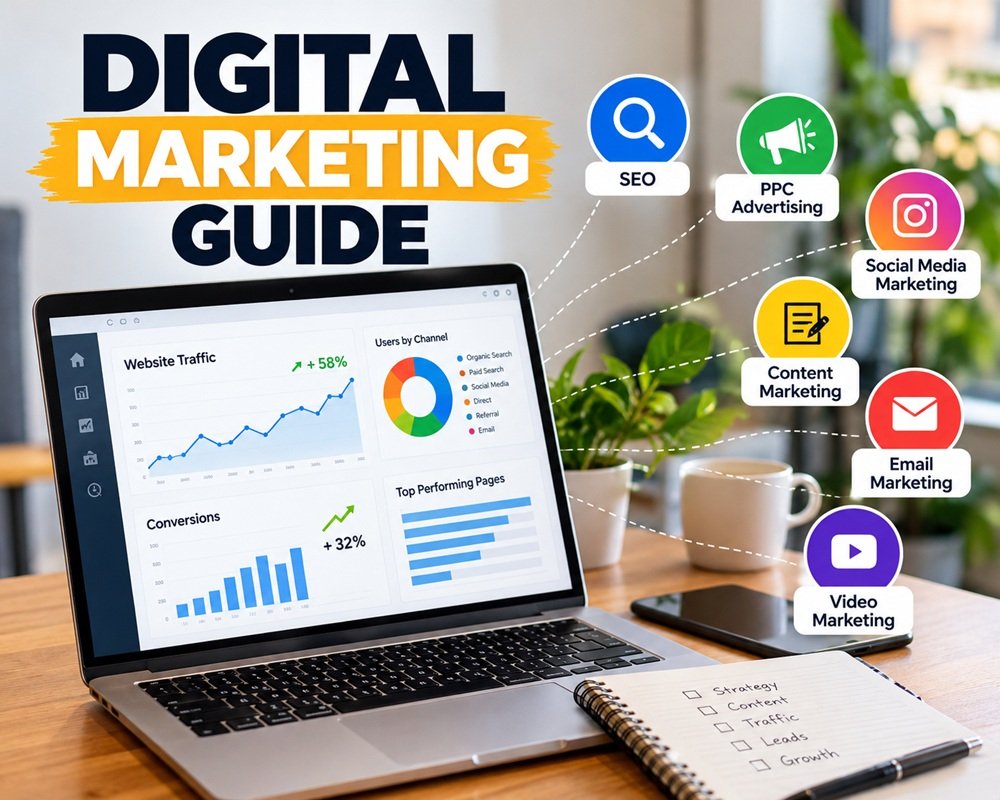



Digital marketing is no longer limited to running ads on Google or posting regularly on social media. For most businesses, it is a combination of different online channels used to attract people, build trust, generate leads, and convert those leads into customers.
The simple idea is this: reach the right people online, give them something useful, and make it easy for them to take the next step.
What Is Digital Marketing?
Digital marketing is the promotion of a business, product, service, or brand through digital channels such as search engines, websites, social media, email, online advertising, video platforms, and mobile apps.
Unlike traditional advertising, digital marketing allows businesses to measure much more of the customer journey—from the first website visit to a lead, sale, or repeat purchase.
Main Types of Digital Marketing
1. Search Engine Optimization (SEO)
SEO helps a website appear in organic search results.
It includes areas such as:
- Keyword research
- On-page SEO
- Technical SEO
- Content optimization
- Internal linking
- Link building
- Local SEO
SEO usually takes time, but a well-optimized website can continue attracting organic visitors without paying for every click.
2. Pay-Per-Click Advertising (PPC)
PPC allows businesses to pay for targeted advertising on platforms such as Google Ads and Microsoft Advertising.
It can be useful when you want immediate visibility for products, services, offers, or specific search terms.
The important part is not simply getting clicks. You need to track whether those clicks generate leads, sales, or other meaningful results.
3. Social Media Marketing
Platforms such as Facebook, Instagram, LinkedIn, TikTok, and X can help businesses reach and engage their audience.
Social media works best when businesses share a mixture of:
- Useful information
- Educational content
- Videos and visuals
- Customer stories
- Product or service information
- Promotional offers
Simply posting every day isn’t a marketing strategy. The content should have a purpose.
4. Content Marketing
Content marketing focuses on creating useful information that attracts potential customers.
Examples include:
- Blog posts
- Guides
- Tutorials
- Videos
- Case studies
- Infographics
- FAQs
Good content should answer a real question or solve a real problem instead of being created only to target keywords.
5. Email Marketing
Email remains useful for staying connected with people who already know your business.
Businesses can use email for newsletters, product updates, promotions, abandoned-cart messages, educational content, and customer follow-ups.
The goal should be to send relevant information—not simply more emails.
6. Video Marketing
YouTube, Instagram Reels, TikTok, and other video platforms have made video an important part of digital marketing.
A simple tutorial, product demonstration, comparison, or short educational video can sometimes communicate more effectively than a long article.
How Does Digital Marketing Work?
A basic digital marketing process looks like this:
Research → Reach → Engage → Convert → Retain
First, understand your audience and competitors. Then choose the channels where your potential customers spend time.
After attracting visitors, give them useful information and build trust. Finally, provide a clear path to take action—such as making a purchase, filling out a form, calling your business, or subscribing.
The process doesn’t stop after the first conversion. Existing customers can become repeat buyers and valuable sources of referrals.
How to Create a Digital Marketing Strategy
You don’t need to use every digital marketing channel from day one.
Start with these steps:
1. Define your goal
Decide whether you want traffic, leads, sales, brand awareness, or customer retention.
2. Understand your audience
Find out what your customers need, what problems they have, and how they search for solutions.
3. Research competitors
Look at their websites, content, search visibility, advertising, social media, and offers.
4. Select the right channels
For example, SEO may be important for a search-driven business, while social media or paid advertising may work better for another.
5. Create useful content
Focus on answering customer questions rather than producing content simply because a keyword has search volume.
6. Measure performance
Use tools such as Google Analytics and Google Search Console to understand traffic, conversions, search performance, and user behavior.
7. Improve continuously
Digital marketing is not a set-and-forget activity. Review the data, identify what is working, and adjust your strategy.
Important Digital Marketing Metrics
Don’t judge a campaign only by impressions or traffic.
Depending on your goal, track metrics such as:
- Organic traffic
- Click-through rate (CTR)
- Leads
- Conversion rate
- Cost per lead
- Cost per acquisition
- Return on ad spend (ROAS)
- Revenue
- Customer retention
The most useful metric is usually the one closest to your actual business objective.
Final Thoughts
Digital marketing is not about being everywhere. It is about being useful and visible in the places where your potential customers are already looking.
Start with a clear goal, understand your audience, choose a few appropriate channels, create genuinely useful content, and measure the results.
SEO can help people discover you. Advertising can provide faster reach. Social media can build engagement. Content can establish expertise. Email can help maintain relationships.
The real advantage comes from making these channels work together rather than treating them as completely separate activities.

Leave a Reply