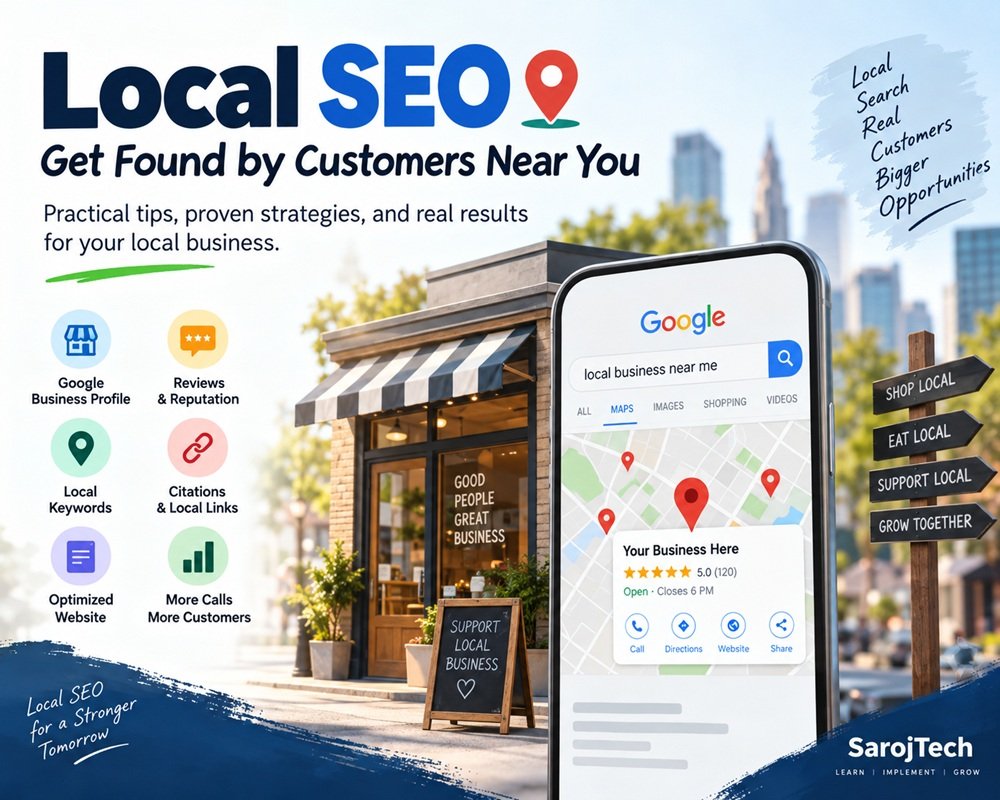



If you run a local business, being visible on Google is not just about ranking for a broad keyword like “furniture store” or “digital marketing agency.” What really matters is showing up when someone nearby is ready to take action.
A person searching for “furniture store near me,” “SEO agency in Delhi,” “best dentist in Sarasota,” or “coffee shop near me” already has a local intent. They are not simply researching. In many cases, they are looking for a business they can call, visit, book, or buy from.
This is where Local SEO comes into play.
Local SEO is the process of improving a business’s visibility in location-based searches on Google and other search platforms. It combines traditional SEO with location-specific signals such as your Google Business Profile, website content, customer reviews, local mentions, links, and business information.
And contrary to what many business owners think, Local SEO is not simply about adding a city name to every page.
What Is Local SEO?
Local SEO is a branch of search engine optimization focused on helping businesses appear in searches connected to a specific geographic area.
For example:
- “plumber in Chicago”
- “Italian restaurant near me”
- “furniture store in Sarasota”
- “digital marketing agency Delhi”
- “car repair shop near me”
Google uses several signals to determine which local businesses are relevant to a search. Google says local results are primarily influenced by relevance, distance, and prominence.
That explains why two people searching for exactly the same business category can sometimes see different results. Their locations, search context, and the businesses around them can differ.
Local SEO is therefore about making it easy for both Google and potential customers to understand who you are, what you offer, and where you operate.
Why Local SEO Matters for Small Businesses
Large brands can often generate visibility through national advertising, strong domain authority, and massive brand recognition.
A local business has a different opportunity.
You don’t necessarily need to compete with every business in the country. You need to become visible to people who are looking for your products or services in the areas you actually serve.
Imagine someone searches:
“best furniture store in Sarasota.”
A local furniture business has an opportunity to appear in:
- Google Maps
- The local results section
- Organic search results
- Google Business Profile
- Location-specific searches
- “Near me” searches
This traffic can be particularly valuable because the searcher has already included location or local intent in the query.
The goal isn’t simply to generate impressions.
The goal is to generate calls, directions, website visits, bookings, enquiries, and customers.
Google Business Profile Is the Starting Point
For eligible local businesses, the Google Business Profile is one of the most important parts of a Local SEO strategy.
Your profile can appear across Google Search and Google Maps and can show important information such as your business name, address, phone number, hours, website, photos, services, and reviews.
Start by making sure your profile is:
- Claimed and verified
- Using the real business name
- Assigned the most appropriate primary category
- Using an accurate address or service area
- Showing correct business hours
- Linked to the correct website
- Using relevant business attributes
- Filled with useful photos
- Updated when important business information changes
Google specifically recommends providing complete and accurate business information because it helps Google understand the business and match it with relevant searches.
Don’t Stuff Keywords Into Your Business Name
This is a common Local SEO mistake.
For example, if the actual business is called:
ABC Dental
Don’t change the profile name to:
ABC Dental – Best Dentist in Delhi – Affordable Dental Clinic
just to target keywords.
Google’s guidelines say the business name should reflect the real-world name of the business. Adding unnecessary information can violate the Business Profile guidelines.
Local SEO should be built around accurate information, not shortcuts.
Choose the Right Business Category
Your primary Google Business Profile category helps Google understand what your business actually is.
A restaurant, law firm, furniture store, plumber, hotel, and marketing agency should not try to describe themselves with dozens of unrelated categories.
Google recommends using as few categories as necessary to describe the core business and choosing categories that are specific and representative.
Think about the question:
“If I could describe this business with one category, what would it be?”
That is usually a good starting point for selecting the primary category.
Additional categories can be used when they genuinely describe other important aspects of the business.
Build Location-Focused Website Pages
Your website is still a major part of Local SEO.
A Google Business Profile alone isn’t a complete Local SEO strategy.
Your website should clearly communicate:
- What your business offers
- Where you operate
- Who you serve
- How customers can contact you
- Why customers should choose you
For businesses serving multiple locations, properly created location pages can be useful.
For example:
/sarasota-furniture-store/
/lakewood-ranch-furniture/
/venice-furniture-store/
But there is an important difference between useful location pages and pages created only to manipulate rankings.
A good location page should provide information that is genuinely useful to someone in that area.
You might include:
- Services available in that location
- Products or solutions
- Address or service area
- Local photos
- Directions
- Opening hours
- Local customer information
- FAQs
- Relevant testimonials
- Nearby areas served
Simply replacing a city name on the same paragraph 20 times doesn’t create a useful local page.
Use Local Keywords Naturally
Keyword research is still important in Local SEO, but keyword placement should sound natural.
Instead of forcing:
“Best SEO agency Delhi, SEO company Delhi, SEO services Delhi, SEO consultant Delhi…”
into one paragraph, build content around the questions your customers actually ask.
For example:
SEO services in Delhi
could lead to content about:
- Local SEO
- Technical SEO
- Google Business Profile optimization
- E-commerce SEO
- Content strategy
- SEO audits
- Monthly SEO services
Use geographic terms where they make sense:
- City
- Neighborhood
- County
- State
- Service area
- Nearby communities
The objective is not to mention the location as many times as possible.
The objective is to make the page clearly relevant to that location.
Reviews Are More Than Social Proof
Customer reviews play an important role in local visibility and customer decision-making.
Google states that review count and review ratings can influence local ranking, as part of the broader concept of prominence.
But reviews also have a second benefit: they help potential customers decide whether to contact your business.
A strong review strategy should focus on getting genuine customer feedback.
Ask customers to review your actual experience with the business. Don’t write fake reviews for them, purchase reviews, or create dozens of artificial accounts.
Also respond to reviews.
A thoughtful response to a positive review can reinforce the relationship with the customer. A professional response to a negative review can show that the business takes customer feedback seriously.
Google itself recommends responding to reviews.
Don’t Turn Reviews Into Keyword Spam
You don’t need to ask every customer to write:
“Best dentist in Delhi.”
Natural reviews are much more useful than manufactured keyword-rich sentences.
Keep Your Business Information Consistent
Another important part of Local SEO is maintaining accurate business information across the web.
Pay attention to:
Name
Address
Phone number
Website
Business hours
This information should be accurate wherever your business is listed.
Google gathers local information from multiple sources, including websites, third-party data, user contributions, and information provided by business owners.
That means your website and other business listings shouldn’t send conflicting signals.
For example:
Your website says:
123 Main Street
while an old directory says:
125 Main Street
and another website has a completely different phone number.
These inconsistencies can create confusion for both customers and search engines.
Local Citations Still Have a Role
A local citation is a mention of your business information on another website or directory.
Examples include:
- Local business directories
- Industry directories
- Chamber of Commerce websites
- Local organizations
- Professional associations
- Relevant business listings
- Local publications
But don’t make the mistake of thinking that hundreds of low-quality directory submissions automatically equal better Local SEO.
Quality and relevance matter.
I’d rather build a small number of trustworthy, relevant local mentions than submit a business to hundreds of questionable directories.
Local Link Building
Backlinks remain useful for SEO, and local businesses can benefit from links that demonstrate genuine local relevance.
Some practical opportunities include:
Local News Websites
If your business has something genuinely newsworthy, local publications may cover it.
Community Organizations
Sponsoring or participating in legitimate community events can sometimes lead to a local mention or link.
Industry Associations
Membership in relevant professional organizations can provide legitimate visibility.
Local Partnerships
Businesses can collaborate on events, guides, interviews, or community projects.
Local Resources
Create useful resources that other local websites might naturally reference.
For example:
“Complete Guide to Moving to Sarasota”
could potentially attract links from local organizations, real estate websites, relocation resources, and community websites if the information is genuinely useful.
The best local links usually come from real relationships and useful contributions rather than automated link-building schemes.
Create Content Around Local Search Intent
Local businesses often underestimate content.
You don’t have to publish five articles every week.
Instead, answer questions your customers actually ask.
A furniture store could publish:
- How to Choose the Right Sofa for a Small Living Room
- Best Furniture for Florida Homes
- How to Protect Outdoor Furniture From Humidity
- Sectional Sofa Buying Guide
- How to Choose a Dining Table Size
A local dentist could publish:
- How Often Should You Visit a Dentist?
- What to Do After a Tooth Extraction
- How Long Does Teeth Whitening Take?
- Dental Care Tips for Families
A local travel business could publish:
- Best Weekend Trips From Delhi
- Places to Visit Near Delhi
- Family-Friendly Destinations From Delhi
- Delhi Airport Travel Guide
The key is to connect useful information with the audience you actually serve.
Add LocalBusiness Structured Data
Structured data can help search engines better understand information about a business.
Depending on the business, relevant structured data can include information such as:
- Business name
- Address
- Phone
- URL
- Opening hours
- Location
- Business type
Google supports structured data for local businesses, but structured data should accurately represent the visible information on the page.
It should not be treated as a shortcut to rankings.
Also be careful with review markup. Google’s guidelines place specific restrictions on review snippets for businesses that control the reviews displayed on their own website.
Don’t Ignore Technical SEO
Local businesses still need a technically healthy website.
Check the basics:
- HTTPS
- Mobile usability
- Page speed
- Crawlability
- Indexation
- XML sitemap
- Robots.txt
- Canonical tags
- Internal links
- Broken links
- Duplicate pages
- Core Web Vitals
- Search Console coverage
A beautifully optimized Google Business Profile won’t compensate for a website that search engines cannot properly crawl or index.
Technical SEO and Local SEO should work together.
Optimize for “Near Me” Searches Without Stuffing “Near Me”
One of the biggest misconceptions about Local SEO is that you need to create pages filled with phrases such as:
dentist near me
restaurant near me
plumber near me
Google doesn’t need you to repeat “near me” dozens of times.
The phrase generally represents the user’s local intent.
Instead, build strong location signals:
- Accurate Business Profile
- Correct address
- Relevant categories
- Location-specific website content
- Genuine reviews
- Local links and mentions
- Accurate business information
Google considers the searcher’s location when determining local results.
Add Real Photos and Videos
Local businesses have something online-only businesses don’t always have: a physical presence.
Use it.
Add authentic photographs of:
- Storefront
- Office
- Staff
- Products
- Services
- Interior
- Exterior
- Events
- Work in progress
Google recommends adding photos and videos to Business Profiles to help customers understand and recognize a business.
For a restaurant, show the food and dining area.
For a furniture store, show the showroom and products.
For a contractor, show completed projects.
Real images can help customers feel more confident before contacting you.
Track the Right Local SEO Metrics
Ranking position isn’t the only thing worth measuring.
A useful Local SEO dashboard can include:
Google Business Profile
- Views
- Calls
- Website visits
- Direction requests
- Search queries
Website
- Organic traffic
- Local landing page traffic
- Phone clicks
- Form submissions
- Conversion rate
Reputation
- Number of reviews
- Average rating
- Review growth
- Review response rate
SEO
- Local keyword visibility
- Indexed location pages
- Organic conversions
- Local backlinks
Ultimately, the important question isn’t:
“Did my keyword move from position 8 to position 5?”
It is:
“Did more local customers discover and contact my business?”
Common Local SEO Mistakes
Here are some mistakes I still see frequently.
1. Keyword stuffing
Adding the same city and keyword repeatedly doesn’t create better content.
2. Fake reviews
Artificial reviews can damage trust and create policy problems.
3. Incorrect business information
Old phone numbers, addresses, and opening hours can confuse customers.
4. Creating hundreds of thin location pages
If every location page contains almost identical content, there may be little value for users.
5. Ignoring Google Business Profile
A website alone isn’t enough for many local businesses.
6. Buying cheap backlinks
A large number of irrelevant links isn’t a substitute for genuine local authority.
7. Using fake locations
A business shouldn’t create profiles for locations where it doesn’t genuinely operate.
Google’s Business Profile guidelines require businesses to accurately represent their real-world presence and location.
A Simple Local SEO Strategy
If you’re starting Local SEO from scratch, don’t try to fix everything in one day.
Use this order:
Step 1: Claim and verify your Google Business Profile.
Step 2: Correct your business name, category, address, phone, hours, website, and service area.
Step 3: Improve your website’s local landing pages.
Step 4: Research local keywords based on real customer intent.
Step 5: Build relevant local citations and business mentions.
Step 6: Develop a genuine customer review process.
Step 7: Create useful local content.
Step 8: Earn relevant local backlinks.
Step 9: Improve technical SEO and page experience.
Step 10: Track calls, leads, website traffic, rankings, and conversions.
Then repeat the process.
Local SEO is rarely a one-time project. Business information changes, competitors improve, new locations open, reviews arrive, and search behavior evolves.
Final Thoughts
Local SEO is often described as a way to “rank on Google Maps.”
That’s only part of the story.
Good Local SEO connects your business, your website, your location, your reputation, and your customers’ search intent.
Google’s own guidance makes it clear that local results are primarily influenced by relevance, distance, and prominence.
You can’t control how far a customer is from your business. You can’t simply pay Google to move your Business Profile to the top either. But you can make your business information more accurate, your website more useful, your local presence more credible, and the customer experience better.
That’s the foundation of sustainable Local SEO.
And for a small business, that can mean the difference between being another name on the internet and being the business a nearby customer actually finds when they need help.
Leave a Reply