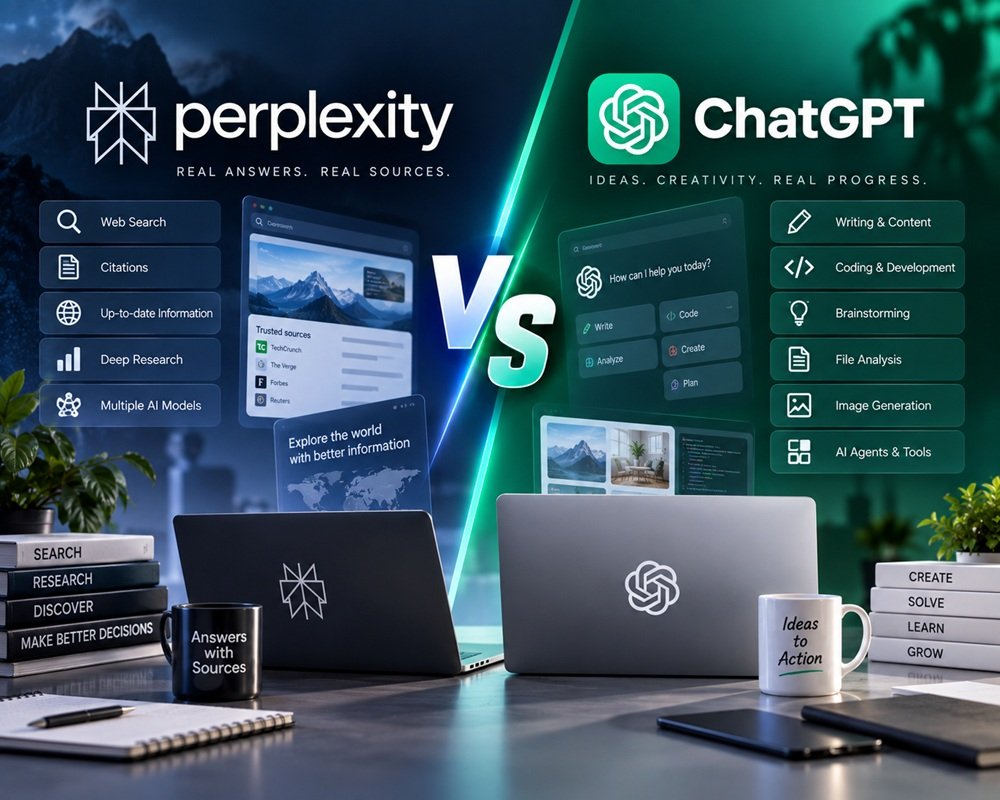



If you spend a lot of time researching online or working with AI, you’ve probably come across two names repeatedly: ChatGPT and Perplexity.
At first, the difference between them was fairly straightforward. ChatGPT was primarily an AI chatbot, while Perplexity positioned itself as an AI-powered search engine.
That distinction isn’t quite as clear anymore.
Perplexity has expanded beyond search with Deep Research, access to multiple AI models, file analysis, Comet and agent-based capabilities. ChatGPT has also evolved significantly, adding web search, Deep Research, advanced reasoning, coding, file and data analysis, image generation and tools for completing more complicated tasks.
So the question isn’t simply which AI is more powerful.
A better question is:
Which one is better for the type of work you actually do?
Let’s compare Perplexity and ChatGPT based on their features, research capabilities, writing, coding, pricing and everyday usefulness.
Perplexity vs ChatGPT at a glance
| Feature | Perplexity | ChatGPT |
|---|---|---|
| Main strength | Web research and cited answers | General-purpose AI |
| Real-time web research | Excellent | Excellent |
| Citations | Excellent | Very good |
| Writing | Very good | Excellent |
| Coding | Very good | Excellent |
| Deep Research | Excellent | Excellent |
| File analysis | Yes | Yes |
| Image generation | Yes | Yes |
| Multiple model providers | Yes | No |
| Agent capabilities | Yes | Yes |
| Best for research | Perplexity | Very good |
| Best for writing | Very good | ChatGPT |
| Best all-rounder | Very good | ChatGPT |
| Free version | Yes | Yes |
| Main paid plan | $20/month | $20/month |
Both platforms offer capable free versions, although the limits and features available without a subscription differ.
The main difference between Perplexity and ChatGPT
The simplest way to understand these platforms is to look at what each one is primarily designed to do.
Perplexity is research-first
You ask a question and Perplexity searches for relevant information, combines what it finds and presents an answer with sources.
The citations are a major part of the experience.
Instead of simply accepting an AI-generated answer, you can open the sources and check where the information came from.
ChatGPT is work-first
ChatGPT can also search the web and provide sources, but its overall purpose is broader.
You can use it for research, writing, brainstorming, coding, data analysis, file analysis, image creation, planning and many other tasks.
This difference becomes more noticeable when you use both platforms regularly.
Perplexity often feels like a smarter research engine.
ChatGPT feels more like a general AI workspace.
1. Perplexity vs ChatGPT for research
Research is probably the area where Perplexity has its clearest advantage.
Suppose you’re researching:
“What are the best CRM platforms for a small business in 2026?”
Perplexity searches the web, organizes the information and provides sources alongside its answer.
That makes it easy to investigate claims rather than simply trusting what the AI tells you.
This can be particularly useful for:
- Bloggers
- Journalists
- Students
- SEO professionals
- Researchers
- Business owners
- Marketing professionals
ChatGPT can also conduct web research and has dedicated Deep Research capabilities.
However, the overall Perplexity interface is built around finding and verifying information.
Winner: Perplexity
For fast, source-heavy web research, Perplexity is usually my first choice.
2. Deep Research
This comparison becomes much closer when we move beyond ordinary searches.
Both ChatGPT and Perplexity offer Deep Research capabilities.
Perplexity’s Deep Research can search multiple sources, cross-reference information, analyze uploaded documents and produce detailed research reports.
ChatGPT’s Deep Research can also perform multi-step research, investigate sources and organize findings into detailed responses.
Both are significantly more useful than asking an ordinary chatbot a complicated research question.
The difference is what you want to do after the research.
If your priority is finding and checking information, Perplexity feels particularly natural.
If you want to turn the research into a strategy, document, analysis or larger project, ChatGPT can be more convenient.
Winner: Very close
Perplexity has an advantage for research-focused work, while ChatGPT becomes particularly useful when research is only the first stage of a larger task.
3. Citations and sources
This is one of Perplexity’s biggest strengths.
Citations aren’t treated as an optional feature. They’re central to how the platform works.
When Perplexity gives you information, it usually makes it easy to see the sources behind the answer.
This is particularly valuable when researching statistics, recent developments or claims that need verification.
For example, imagine you’re writing:
“AI adoption among small businesses has increased significantly.”
You shouldn’t simply publish that because an AI said it.
You need to know:
Where did the information come from?
Perplexity makes that verification process convenient.
ChatGPT can also provide sources when using its web search and research capabilities, but Perplexity remains particularly strong at presenting research and citations together.
Winner: Perplexity
4. Which is better for writing?
For writing, I prefer ChatGPT.
Perplexity can certainly generate articles, summaries, emails and other written content.
However, ChatGPT works particularly well when writing becomes an iterative process.
For example, you might start with:
“Write an article about AI tools for small businesses.”
Then continue:
“Make the introduction more conversational.”
Then:
“Add examples for US businesses.”
Then:
“Remove unnecessary technical language.”
Then:
“Rewrite the conclusion.”
That back-and-forth process feels natural in ChatGPT.
It’s useful when you’re not looking for a single answer but want to gradually develop and improve something.
Winner: ChatGPT
5. Perplexity vs ChatGPT for coding
Both platforms can help with programming.
You can use them for tasks such as:
- Writing code
- Debugging errors
- Explaining unfamiliar code
- Creating scripts
- Refactoring
- Understanding programming concepts
- Building prototypes
- Researching technical documentation
ChatGPT has become particularly strong for coding and software-development workflows.
It works well when you’re solving a problem over multiple steps rather than simply asking for one piece of code.
Perplexity also offers strong coding capabilities, particularly because paid users can access multiple advanced AI models.
This can be useful when you want to compare how different models approach the same technical problem.
Winner: ChatGPT
For general coding and development workflows, ChatGPT has the advantage.
6. Access to multiple AI models
This is one of Perplexity’s most interesting features.
Perplexity isn’t limited to a single AI model provider.
Depending on your subscription, you can access models from several leading AI companies.
That means you can potentially use different models depending on the task you’re working on.
One model might perform particularly well for research.
Another might be better for reasoning.
Another could be useful for coding.
For people who enjoy testing different AI models, this makes a Perplexity subscription particularly interesting.
ChatGPT takes a different approach.
It is primarily built around OpenAI’s own models and tools.
Winner: Perplexity
If access to models from multiple AI companies matters to you, Perplexity has a clear advantage.
7. File and document analysis
Both platforms allow users to upload and analyze files.
You can use them with:
- PDFs
- Reports
- Documents
- Research papers
- Spreadsheets
- Business information
- Other supported files
The difference again comes down to what you’re trying to accomplish.
With Perplexity, a useful request might be:
“Analyze this report and find recent information online that supports or challenges its conclusions.”
With ChatGPT, you might say:
“Analyze this spreadsheet, identify important trends and create a strategy based on the results.”
There is plenty of overlap between the two.
Winner: Tie
Both are useful for document and file analysis.
8. Image generation
Both platforms now offer image-related AI capabilities, although this isn’t the main reason I would choose Perplexity.
ChatGPT integrates image generation and editing into its wider AI workflow.
That makes it convenient when you’re already using ChatGPT to create content and then need a supporting visual.
For example, you could research an article, write it, create a featured image and then develop social media content around it without leaving the same AI environment.
Perplexity also provides image generation capabilities on eligible plans.
Winner: ChatGPT
For a broader creative workflow, ChatGPT is the more natural choice.
9. AI agents
This is one of the most interesting areas of competition.
AI platforms are moving beyond simply answering questions.
They’re increasingly being designed to perform multiple steps toward a goal.
For example, instead of asking:
“Which laptops are good for video editing?”
You could ask an AI agent to:
“Find five laptops suitable for video editing, compare their specifications and current prices, and create a shortlist.”
That requires research, comparison, organization and decision-making.
Perplexity has been expanding into this area with its Computer capabilities and Comet browser.
ChatGPT is also developing increasingly sophisticated agent-based workflows.
This category is moving so quickly that choosing a permanent winner doesn’t make much sense.
Winner: Too close to call
10. What is Perplexity Comet?
Comet is another important part of Perplexity’s strategy.
Instead of separating web browsing from AI, Comet brings AI directly into the browsing experience.
This can be particularly useful if much of your day involves:
- Researching websites
- Comparing products
- Reading articles
- Looking for statistics
- Checking competitors
- Gathering information
Instead of constantly switching between a browser, search engine and AI assistant, the AI can participate directly in your browsing workflow.
This makes Comet particularly interesting for researchers, marketers, journalists and SEO professionals.
11. Perplexity vs ChatGPT pricing
Price is one area where the comparison is straightforward at the main consumer subscription level.
Perplexity Pro
Perplexity Pro costs approximately $20 per month, with an annual subscription option also available.
The plan provides higher usage limits and access to features such as advanced AI models, Pro Search, Deep Research, file analysis and other tools.
One of its major advantages is access to models from multiple providers.
ChatGPT Plus
ChatGPT Plus costs $20 per month.
It provides expanded access to ChatGPT’s models and features, including advanced reasoning, web capabilities, file uploads, image generation and research tools, subject to the limits of the plan.
Both companies also offer more expensive plans aimed at heavy or professional users.
Pricing comparison
| Feature | Perplexity Pro | ChatGPT Plus |
|---|---|---|
| Monthly price | $20 | $20 |
| Free version | Yes | Yes |
| Web search | Excellent | Excellent |
| Citations | Core strength | Available |
| Deep Research | Yes | Yes |
| Multiple model providers | Yes | No |
| File analysis | Yes | Yes |
| Image generation | Yes | Yes |
| Coding | Very good | Excellent |
| Agent capabilities | Yes | Yes |
| Best suited for | Research | General-purpose AI |
Because the prices are similar, I wouldn’t choose based on cost alone.
I’d choose based on how you intend to use the platform.
12. Which is better for SEO professionals?
For SEO work, Perplexity is particularly useful for research.
You can use it for:
- Competitor research
- Industry research
- Finding statistics
- Discovering sources
- Researching topics
- Understanding products and markets
- Tracking recent developments
ChatGPT is useful for a different stage of the workflow.
You can use it for:
- Keyword clustering
- Content briefs
- Content outlines
- Content analysis
- Article development
- Editing
- Schema ideas
- Strategy
- Brainstorming
A practical workflow would be:
Use Perplexity to research.
Then:
Use ChatGPT to analyze, organize and develop the content.
The two tools can complement each other rather than compete.
13. Which is better for students?
Perplexity has a natural advantage for research-heavy academic work because it makes sources easy to inspect.
Students can use it to find:
- Background information
- Research papers
- Recent information
- Statistics
- Different perspectives
But students should still open and verify the original sources rather than citing an AI-generated summary.
ChatGPT is particularly useful after you’ve collected the material.
For example:
“Explain this concept in simpler language.”
“Create revision notes from this chapter.”
“Quiz me on this topic.”
“Help me understand where my answer went wrong.”
Best for student research: Perplexity
Best general study assistant: ChatGPT
14. Which is better for business?
The answer depends on the type of work your business does.
If your team spends a lot of time researching:
- Competitors
- Markets
- Products
- Customers
- Industry developments
Perplexity can be extremely useful.
If your team needs help with:
- Writing
- Data analysis
- Coding
- Brainstorming
- Planning
- Documents
- Creative work
ChatGPT is probably the broader choice.
For marketing and research teams, having access to both can make sense.
15. Which is better for everyday use?
Think about the type of question you’re asking.
If you ask:
“What are the best CRM platforms for a 10-person company in 2026?”
I’d probably start with Perplexity because I want current information, comparisons and sources.
But if I ask:
“Help me create a CRM strategy for my 10-person company.”
I’d probably use ChatGPT.
The first question is primarily about finding information.
The second is about thinking through a problem.
That distinction explains much of the difference between the two platforms.
The biggest weakness of Perplexity
Perplexity is extremely good at gathering information.
But gathering information isn’t the same as making a good decision.
You may receive a well-researched answer with plenty of sources and still need to determine:
What matters most?
Which option is right for me?
What should I do next?
This is where a broader conversational and reasoning workflow can become valuable.
The biggest weakness of ChatGPT
ChatGPT has almost the opposite problem.
Because it can do so many things, it’s tempting to use it for everything.
But when your primary objective is finding current information and quickly inspecting the sources behind it, Perplexity’s research-focused interface can be more direct.
ChatGPT can research.
Perplexity was designed around research.
That’s still an important difference.
Perplexity vs ChatGPT: Which should you choose?
Choose Perplexity if you:
- Conduct a lot of web research
- Want citations with your answers
- Need current information
- Compare products and services
- Research competitors
- Work in SEO or journalism
- Want access to models from different AI companies
- Prefer a search-focused experience
For these tasks, Perplexity is my preferred option.
Choose ChatGPT if you:
- Write regularly
- Code
- Analyze files or data
- Brainstorm ideas
- Work on longer projects
- Need a general-purpose AI assistant
- Want research combined with analysis
- Need creative tools
For these tasks, ChatGPT is my preferred option.
Should you use both?
If your work involves a lot of research and content creation, using both can actually make sense.
Here’s a simple workflow.
Step 1: Research with Perplexity
Find current information, sources, statistics and competing viewpoints.
Step 2: Analyze with ChatGPT
Take the information and work through what it actually means.
Step 3: Create with ChatGPT
Develop your article, report, strategy or other content.
Step 4: Verify important claims
Return to original sources and confirm important facts before publishing.
This is often more effective than expecting one AI platform to be best at every stage.
Perplexity vs ChatGPT: Final verdict
After comparing both platforms, I don’t think Perplexity and ChatGPT are perfect substitutes for each other.
Their strengths overlap, but their priorities are different.
Perplexity is the better research-focused AI tool.
Its citation-first approach, web research capabilities and access to multiple models make it particularly useful when finding reliable and current information is the priority.
ChatGPT is the better general-purpose AI workspace.
It is particularly strong when your work moves beyond finding information into writing, reasoning, coding, data analysis, brainstorming and creating finished work.
The gap between them is getting smaller.
Perplexity continues to expand beyond search, while ChatGPT continues to improve its web research and agent capabilities.
So rather than asking:
“Which AI is better?”
Ask:
“What am I trying to accomplish?”
If you need to find, research and verify information, start with Perplexity.
If you need to think, analyze, create and execute, start with ChatGPT.
And if your work regularly involves both, using the two together can be a very effective combination.
Final comparison
| Category | Better Choice |
|---|---|
| Web research | Perplexity |
| Citations and sources | Perplexity |
| Current information | Perplexity |
| Deep Research | Very close |
| Writing | ChatGPT |
| Coding | ChatGPT |
| Brainstorming | ChatGPT |
| File analysis | Tie |
| Image generation | ChatGPT |
| Multiple model access | Perplexity |
| AI agents | Very close |
| SEO research | Perplexity |
| Overall flexibility | ChatGPT |
| Best research tool | Perplexity |
| Best all-round AI | ChatGPT |
The short answer
For research: Perplexity.
For writing, coding, analysis and general-purpose work: ChatGPT.
For serious research and content workflows: consider using both.

Leave a Reply